
https://pickerwheel.com/emb/?choices=Jan,Feb,Mar,Apr
First of all, if you followed my suggestion and purchased the Norton Critical Edition of The Prince, you have an informative historical introduction: read it! While ‘The Prince’ speaks to all ages, the work is a product of a specific historical moment. Though known mostly for his political philosophy, Machiavelli was first and foremost a professional statesman and secondarily something akin to a 16th-century political and military consultant. He also wrote history, drama, and even novels. He may have intended to promote a new style of ‘scientific’ statecraft — musing upon diplomacy and state administration according to certain rules or maxims (and under the influence of Classical texts) — in order to produce a change in the governing practices of his own day, of which he seems to have had a low opinion. Systematic and self-conscious statesmanship, Machiavelli believed, could bring Italy under human control and save her from the chaos that had erupted after the invasion of the French in 1494. The wars that engulfed Italy after that first momentous invasion by King Charles VIII shocked and astounded Italians and, in the words of one historian (H.Butterfield), “the country seemed moved, as we were moved after the War of 1914, to enter upon a more intensive self-examination.”
Reading Machiavelli, or any of the Great Books for that matter, is not easy. According to Leo Strauss, books like this do not reveal their full meaning as intended by the author unless one ponders them for a very long time. I’ve been pondering this one for over thirty years and it is still revealing itself. You should never walk away from a first reading thinking you have got the whole thing figured out. Nor should you get frustrated by thinking you haven’t cracked the code. Understanding that the ideas in Great Books have been investigated and debated for hundreds of years is the first step to entering the Great Conversation. Yes, reading at this level is difficult and takes some grit.
Recall Mortimer Adler’s point about educated people.
What is required for mastery is a lively and insatiable interest. This is the thing that cannot be faked. And this is also what makes it impossible to ‘climb’ into an educated society under false pretenses as people do into snobbish, moneyed, or artistic circles. The brotherhood of educated men is the one social group which our century cannot open to all by legislative fiat. The irony is that those within have no desire to keep it exclusive — the more the merrier, provided they are the genuine article.
It is no secret that the key element to education — and I mean ‘education’ not learning; they are different — is reading for enlightenment rather than reading for information alone.
To paraphrase Mortimer Adler, one of the founders of the Great Books Program, great ideas seek truth and must be discussed seriously. They demand more than idle chit-chat. Reading for enlightenment demands your full attention and engagement. Good readers carry on a dialogue with their books and will have a collection of written notes (reactions, ideas, and questions) afterward. (This is why I encourage you all to begin reading journals of your own, something that is separate, and entirely different, from class notes that generally record information.) Spark Notes or a Wiki article WILL NOT lead to an enlightened understanding of a text; effective reading requires work and skill.
Only books worth reading this way are the books over your head. The Great Books are the books that are worth everybody’s reading because they are over everybody’s head all the time. (M. Adler)
You should read documents, especially those such as ‘The Prince’ that have achieved special status in the Western canon, differently from the way you approach a history textbook. Active reading MUST be cultivated. That means stay awake, ask questions, and write. Here are a few questions to consider while you read:
- What does the text say? Can you summarize it in your own words (if yes, WRITE that summary in your notes or in the book)?
- What does the text mean? This is the question that drives academic careers. Did the author write satirically or allegorically? What did he or she really want you to take away from the work?
- How does the text relate to the period in which it was written?
- What problem/issue is the author addressing or trying to solve?
- What are the author’s propositions (theses)? Can you paraphrase the author’s argument? (DO it in your notes!)
- What of it? Is it true?
- How does the text relate to others on the topic? (Thucydides?)
- How does the text challenge your own notions of the topic?
And, of course, we need to ask the question what went into writing the great book?, i.e. what explains the particular literary event? What was the context of writing? WHY did the author write?
Herbert Butterfield says that nothing more greatly affects our interpretation of a book such as The Prince than the expectations we bring to the reading of it. “We are easily induced to intercept the author’s meaning by translating it into categories of our own, and if we have been led to focus our attention upon the wrong points we can easily convince ourselves that we have seen what we want to see…. It is important, therefore, that we should interpret Machiavelli in the light of his own aims and avowed intentions, seeking to know what his books signified to himself.” Therefore, we should avoid the temptation to impose upon Machiavelli our own assumptions and modern mentality. Rather, we must locate the writing in time and place and seek to discover the author’s own aims and intentions.
Below are some of the important historical persons you should particularly follow throughout the text.
Pope Sixtus IV, r.1471-84
Pope Alexander VI(Borgia), r.1492-1503
Cesare Borgia
Francesco Sforza
Pope Julius II, r.1503-13
Pope Leo X (Medici), 1513-21
Pope Clement VII (Medici), r.1523-34
Ferdinand of Aragon
Savonarola
Charles VIII of France
Louis XII of France
Maximilian I, Holy Roman Emperor
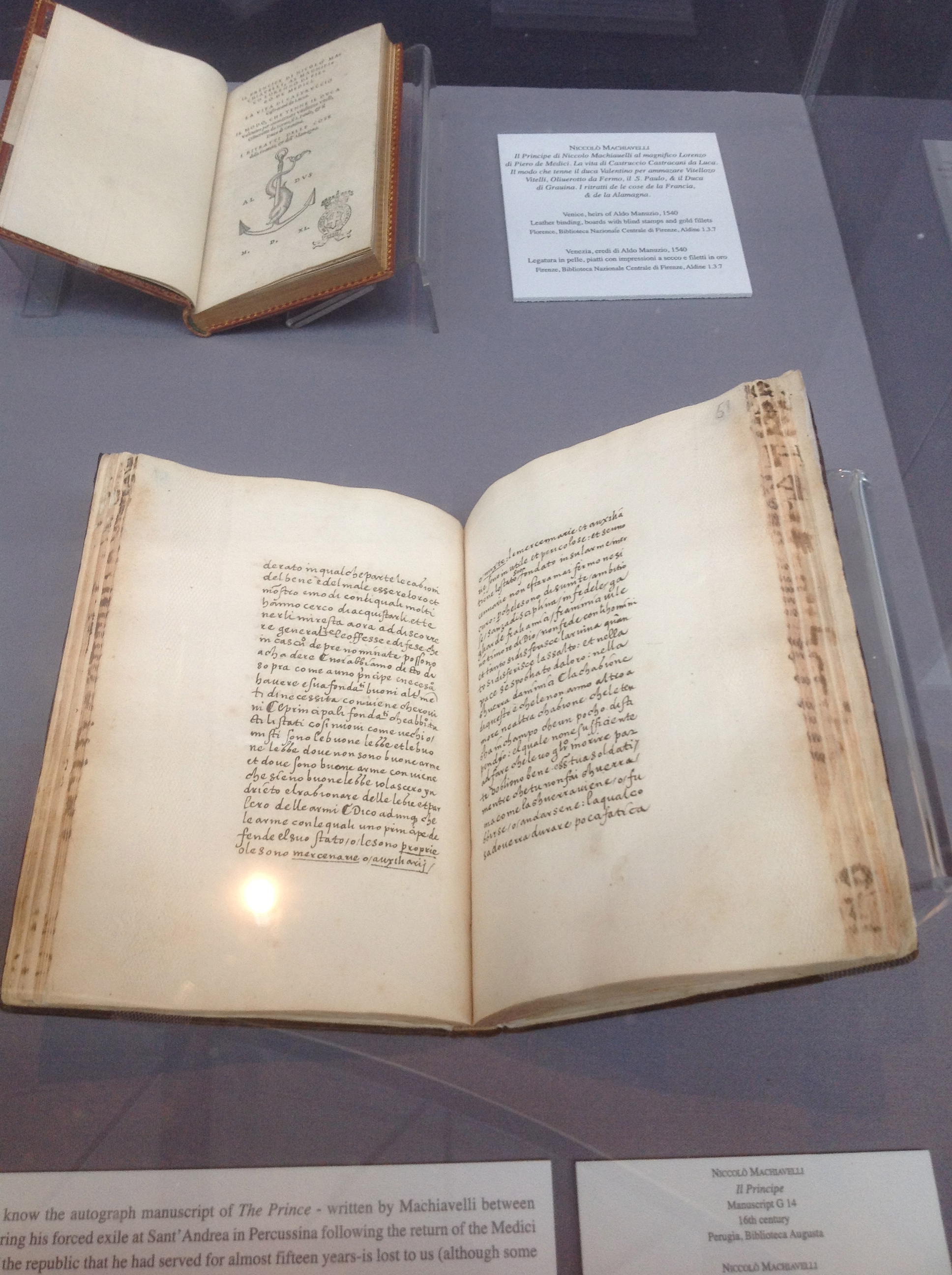
16th-century manuscript of ‘The Prince’
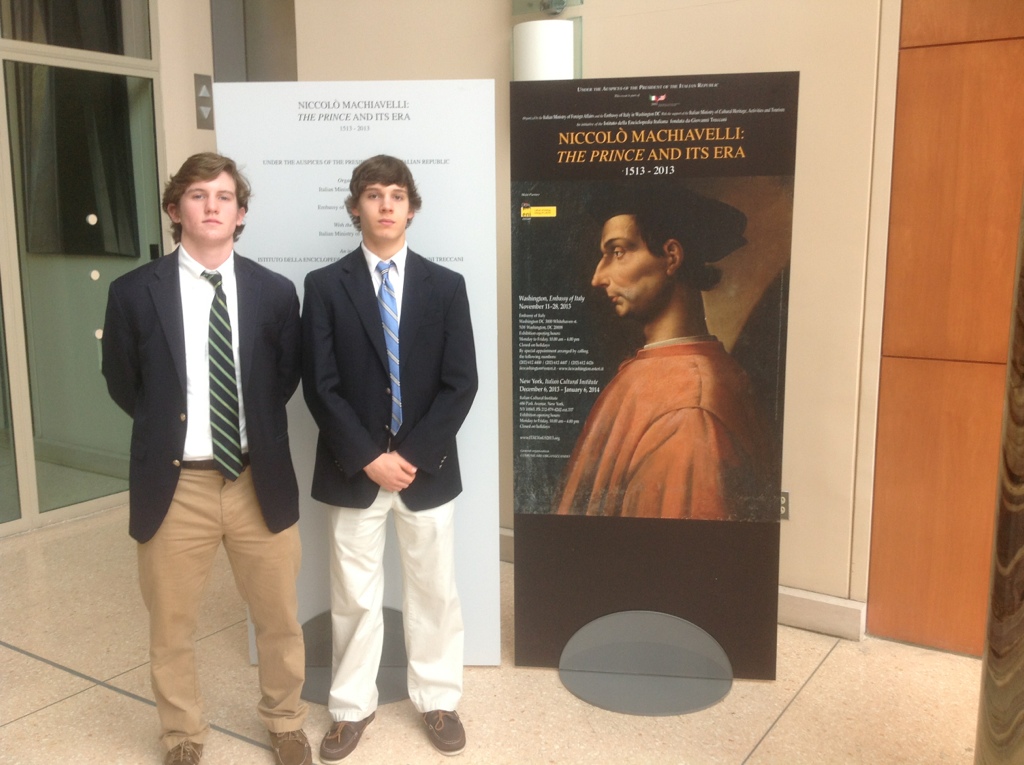
AP Euro class of ’14 at the Italian Embassy celebrating the 500th anniversary of ‘The Prince’ [the guy on the right is now has his PhD in philosophy from Princeton]
 European History
You must be logged in to post a comment.