
1.
The victorious Soviet forces, after annihilating the army of Fascist Germany, removed painting from the colletion of the Dresden Art Gallery and took them to Moscow. These paintings were then locked away for ten years. In the spring of 1955 the Soviet government decided to return these paintings to Dresden. First though, they were to be exhibited in Moscow for three months. And so, on a cold morning of 30 May, 1955, I walked along the Volkhonka, past the lines of policemen controlling the huge crowds who wanted to see the works of the Old Masters. I entered the Pushkin Museum, climbed the stairs to the first floor, and went up to ‘The Sistine Madonna’. As soon as you set eyes on this painting, you immediately realize one thing, one thing above all: that it is immortal…
Looking at ‘The Sistine Madonna’, our own epoch glimpses its own fate. Every epoch contemplates this woman with a child in her arms, and the tender, moving, and sorrowful sense of brotherhood comes into being between people of different generation, nations, races, and eras. Conscious now of themselves and the cross they must bear, people suddenly understand the miraculous links between different ages, the way everything that ever has lived and ever will live is linked to what is living now.
2.
Afterwards, as I was walking back down the street, stunned and confused by these sudden and powerful impressions, I made no attempt to unravel my various feelings and thoughts. My confusion of feeling was nothing like the days of tears and joy I had known when I first read War and Peace at the age of fifteen, nor did it resemble what I had felt when I listened to Beethoven during a particularly somber and difficult time in my life. And then I realized that the vision of a young mother with a child in her arms had taken me back not to a book, not to a piece of music, but to Treblinka:
It is these pines, this sand, this old tree stump that millions of human eyes saw as their freight wagons came slowly up to the platform… We enter the camp. We tread the earth of Treblinka. The lupine pods split open at the least touch; they split with a faint ping… The sounds of the failing peas and the bursting pods come together to form a single soft, sad melody. It is as if a funeral knell — a barely audible, sad, broad, peaceful tolling — is being carried to us from the very depths of the earth… Her they are: the half-rotted shirts of those who were murdered, their shoes, little cogwheels from watches, penknives, candlesticks, a child’s shoes with red pompoms, an embroidered towel from Ukraine, lace underwear, pots, jars, children’s plastic mugs, letters penciled in a childish scrawl, small volumes of poetry…
We walk on over the swaying, bottomless earth of Treblinka and suddenly come to a stop. Thick wavy hair, gleaming like burnished copper, the delicate lovely hair of a young woman, trampled into the ground; and beside it, some equally fine blond hair; and then some heavy black plaits on the bright sand; and then more and more…
And the lupine pods keep popping open, and the tiny peas keep pattering down — and this really does all sound like a funeral knell rang by countless little bells from under the earth. And it feels as if your heart must come to a stop now, gripped by more sorrow, more grief, more anguish than any human being can endure…
What had surfaced in my soul was the memory of Treblinka, though at first I had failed to realize this. It was she, treading lightly on her little bare feet, who had walked over the swaying earth of Treblinka; it was she who had walked from the ‘station’, from where the transports were unloaded, to the gas chambers. I knew her by the expression on her face, by the look in her eyes. I saw her son and recognized him by the strange, unchildlike look on his own face. This was how mothers and children looked, this was how they were in their souls when they saw, against the dark green of the pine trees, the white walls of the Treblinka gas chambers.
How many time had I stared through the darkness at the people getting out of the freight wagons, but their faces had never been clear to me. Sometimes their faces had seemed distorted by extreme horror, and everything had dissolved in a terrible scream. Sometimes despair and exhaustion, physical and spiritual, had obscured their faces with a look of blank, sullen indifference. Sometimes the carefree smile of insanity had veiled their faces as they left the transport and walked toward the gas chambers.
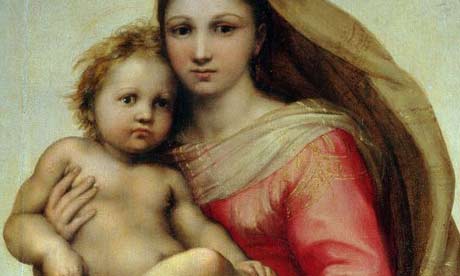
And now at last I had seen these faces truly and clearly. Raphael had painted them four centuries earlier. This is how someone goes to meet their fate. The Sistine Chapel… The Treblinka gas chambers… In our days a young woman brings a child into the world. It is terrifying to be holding a child against one’s heart and hear the roar of the crowds welcoming Adolph Hitler. The mother gazes into the face of her newborn son and hears the ringing and crunching of breaking glass, and the howling of car horns. On the streets of Berlin a wolfish choir is singing the ‘Horst Wessel Song’. From the Moabit prison comes the dull thud of an ax.
The mother breast feeds her baby, and thousands of thousands of men build walls, lay barbed wire, and construct barracks. And in quiet offices men design gas chambers, mobile gassing vans, and cremation ovens. A wolfish time had come, the time of Fascism. It was a time when people led wolfish lives and wolves lived like people.
During this time the young mother was raiser her child. And a painter by the name of Adolph Hitler stood before her in the Dresden Art Gallery; her was deciding her fate. But the ruler of Europe could not look into her eyes, nor could he meet the gaze of her son. Both she and her son, after all, were people.
Their human strength triumphed over this violence. The Madonna walked toward the gas chamber, treading lightly on her small bare feet. She carried her son over the swaying earth of Treblinka. German Fascism was destroyed. The war carried away tens of millions of people. Huge cities were reduced to ruins.
In the spring of 1945 this Madonna first saw our northern sky. She came to us not as a guest, not as a foreign tourists, but in the company of soldiers and drivers, along the smashed roads of the war. She is part of our life; she is our contemporary. She has seen everything before: our snow, the cold autumn mud, soldiers’ dented mess tins with their murky gruel, a limp onion with a crust of black bread. She has walked alongside us; she has traveled for six weeks in a screeching train, picking lice out of her son’s soft, unwashed hair.
She is a contemporary of the total collectivization of agriculture.
Here she is, barefoot, carrying her little son, boarding a transport train. What a long path lies ahead of her — from Oboyan near Kursk, from the black-earth region of Voronezh, to the taiga, to the marshy forests beyond the Urals, to the sands of Kazakhstan.
And where is your father, little one? Where did he perish? In some bomb crater? Felling logs in the taiga? In some dysentery barrack?
Vanya, Vanya, why are you looking so sad? Fate took you away from the hut where you were born, nailing a wooden cross over its windows. What long journey lies ahead of you? Will you reach its end? Or will you come to an end of your strength and die somewhere along the way, in a station on the narrow-gauge railway, on the swampy bank of some little river beyond the Urals?
Yes, it was she. I saw her in 1930, in Konotop, at the station. Swarthy from hunger and illness, she walked toward the express train, looked up at me with her wonderful eyes, and said with her lips, without any voice, “bread…”
I saw her son, already thirty years old. He was wearing worn-out soldiers’ boots — so completely worn out that no one would even take the trouble to remove them from the feet of a corpse — and a padded jacket with a large hole exposing his milk-white shoulder. He was walking along the path through a bog. A huge cloud of midges was hanging above him, but he was unable to drive them away; he was unable to remove this living, flickering halo because he needed both of his hands to steady the damp heavy log on his shoulder. At one moment he raised his bowed head. I saw a fairly curly beard, covering his whole face. I saw his half-open lips. I saw his eyes — and I knew at once. They were the eyes that look out from Raphael’s painting.
We met his mother more than once in 1937. There she was — holding her son in her arms for the last time, saying goodbye to him, gazing into his face and then going down the deserted staircase of a mute, many-storied building. A black car was waiting for her below; a wax seal had already been affixed to the door of her room. How mute the tall buildings, how strange and watchful the silence of the ash-gray dawn…
And out of the half-light before dawn emerges her new life: a transport train, a transit prison, sentries looking down from wooden watchtowers, barbed wire, night shifts in the workshops, boiled water in place of tea, and bed boards, bed boards, bed boards…
With his slow soft stride, wearing his low-heeled kid-leather boots, Stalin went up to the painting and, stroking his gray moustache, gazed for a long, long time at the faces of mother and son. Did he recognize her? He had met her during his own years of exile in eastern Siberia, in Novaya Uda, in Turukhansk and Kureisk. He had met her in transit prisons. He has met her when prisoners were being transferred from one place of exile to another. Did he think of her later, during the days of grandeur?
But we, we people, we recognized her, and we recognized her son too. She is us; their fate is our own fate; mother and son are what is human in man. And if some future time takes the Madonna to China, or to the Sudan, people will recognize her everywhere just as we have recognized her today.
The painting speaks of the joy of being alive on this earth; this too is a source of its calm, miraculous power. The whole world, the whole vast universe, is the submissive slavery of inanimate matter. Life alone is the miracle of freedom. And the painting also tells us how precious, how splendid life has to be, and that no force in the world can compel life to change into some other thing that, however it may resemble life, is no longer life.
The power of life, the power of what is human in man, is very great, and even the mightiest and most perfect violence cannot enslave this power; it can onnly kill it. This is why the faces of the mother and child are so calm: they are invincible. Life’s destruction, even in our iron age, is not its defeat.
Young or gray-haired, we who live in Russia stand before Raphael’s Madonna. We live in troubled time. Wounds have not yet healed, burned out buildings still stand black. The mounds have not yet settled over the shared graves of millions of soldiers, our sons and brothers. Dead, blackened poplars and cherry trees still stand guard over the partisan villages that were burned to the ground. Tall dreary grasses and weeds grow over the bodies of people who were burned alive: grandfathers, mothers, young boys and girls. Over the ditches that contain the bodies of murdered Jewish children and mothers the earth is still shifting, still settling into place. In countless Russian, Belorussian, and Ukrainian huts widows are still weeping at night. The Madonna has suffered all this together with us — for she is us, and her son is us.
And all this is frightening, and shaming, and painful. Why has life been so terrible? Are you and I not to blame? Why are we alive? A difficult and terrible question — only the dead can ask it. Yet the dead are silent; they ask nothing.
Every now and then the postwar silence is disrupted by the thunder of explosions, and a radioactive cloud spread across the sky. And then the earth on which we live shudders; the atom bomb has been replaced by the hydrogen bomb. Soon we must see ‘The SIstine Madonna’ on her way. She has lived with us; she has lived our life. Judge us then, judge us all — along with the Madonna and her son. Soon we will leave life; our hair is already white. But she, a young mother carrying her son in her arms, will go forward to meet her fate. Along with a new generation of people, she will see int e sky a blinding, powerful light: the first explosion of a thermonuclear bomb, a superpowerful bomb heralding the start of a new, global war.
What can we, people of the epoch of Fascism, say before the court of the past and the future? Nothing can vindicate us. We will say, “There has been no time crueler than ours, yet we did not allow what is human in man to perish.” Seeing ‘The Sistine Madonna’ go on her way, we preserve our faith that life and freedom are one, that there is nothing higher than what is human in man. This will live forever and triumph.
 European History
You must be logged in to post a comment.