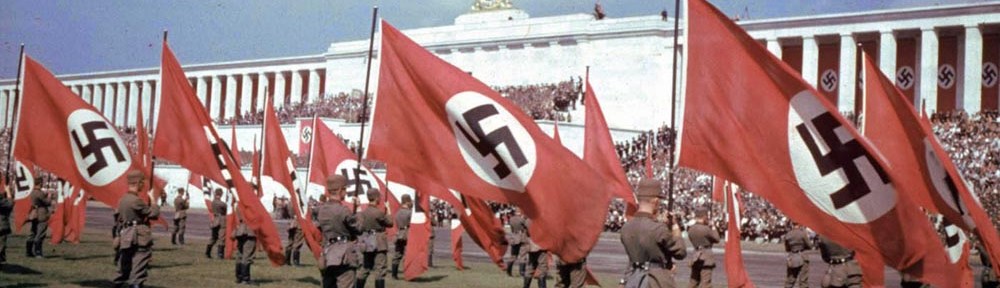
Totalitarian theorists have noted struggles between party and state as well as the proliferation of surveillance organizations seeking to control both.
In ‘totalitarian’ regimes formal sovereignty was vested in a single ruling party and ultimately in the person of its Supreme Leader. Hitler was unchallenged, Stalin became so. Yet this fostered less bureaucracy than despotism. Like any Roman Emperor the leader’s power was arbitrary. If power is rule-governed, then a bureaucratized party of ministerial institutions can administer them. Neither despot nor their party entourages wanted this and so they dispensed with the laws and administrative rules necessary to bureaucracy….
Thus it is no surprise that critics of totalitarianism revealed fierce Nazi and Bolshevik power struggles between party, state, and para-military institutions, resulting in ‘satraps’, ‘fiefdoms’, and ‘departmental patriotisms’. The center was factionalized, far more so than in democracies. True, the Soviet Politburo had formal collective responsibility for policy. No such supreme body existed in Nazi Germany after 1938, when the Reich Cabinet last met. Yet the Politburo was largely supine under Stalin….
Germans, Russians, conservatives, and Marxists have found it especially hard to comprehend the evil that perverted their countries and ideologies. It may console to describe the perpetrators of evil as mad and their regimes as chaotic: evil is removed from our normal world and attributed to a sudden descent into an abyss of madness and chaos….
We all readily appreciate the revolutionary utopian tradition represented by Marxism and Bolshevism, and can agree that Stalinism intensified and perverted this tradition. Yet to call the Nazis ‘revolutionary’ is contentious. Since states with liberal and Marxist ideologies won the two world wars, they are familiar to us. Yet there have been two major power actors of modern times, classes and nation-states. And so there have been two great types of modern social ideology: that analyzing society in terms of classes and that analyzing society in terms of nation-states. Because extreme ‘nation-statist’ ideologies like the Nazis were defeated, their ideas now have little resonance. We have difficulty understanding their revolutionary aspirations.
The Nazis were certainly not class revolutionaries. They suppressed communists and trade unions, believed strongly in managerial hierarchies, and received (discreetly) support from reactionary elites. But, along with most nation-statists, they had little interest in classes or economics. Their economic programme was a rag-bag of incompatible bribes to different social groups. Yet they were revolutionary nation-statists. Their vision was not of a world of classes but of nation-states founded essentially on races, struggling for absolute domination. ‘Order’ could only be imposed violently, first on Germany and then on other inferior races and nations. A strong nation-state provided the order, indeed the moral basis, of society.
Thus, though Hitler himself was uninterested in economics, he intervened actively in diplomacy, military issues, armaments, racial matters, propaganda, and architecture. These had been his concerns in Mein Kampf. The Nazi’s central concern was to make Germany strong, forcibly to restore within and to force enemies to give ground abroad. The Nazis were what they claimed, a national party, a Volkspartei, drawing support from all social classes for their supposedly national goals.
Nazi ideology appalls us. But it was only an extreme version of a whole family of early 20th century rightist ideologies centering the supposed virtues of order, hierarchy, and militarism on the nation-state…. Most endorsed far less racism and violence than the Nazis….
Fifty years after their defeat nation-statist ideas seem bizarre. It is not very likely a nazi, even a fascist, regime might return. It is far more likely we will face a new offspring of a nation-statist family.
 European History