
When I read a book for research, I use a 5-by-8-inch index card as both a bookmark and a research aid. Whenever I come upon a (literally) note-worthy event, or the story of a fascinating character, I write the page number on an index card. Rather than continually interrupt the flow of my reading to capture notes, I scribble the first few words of the section that interested me, gradually filling each card with page numbers and sketchy notes. At some later point – while in “transcribe-mode” – I return to the book and type the relevant information into one of my subject-oriented Word files. This enables me to read without continual interruptions to record my findings.
As always, as I read Britain Alone, I kept track of each interesting, research-worthy section on the index card that served double-duty as a bookmark.
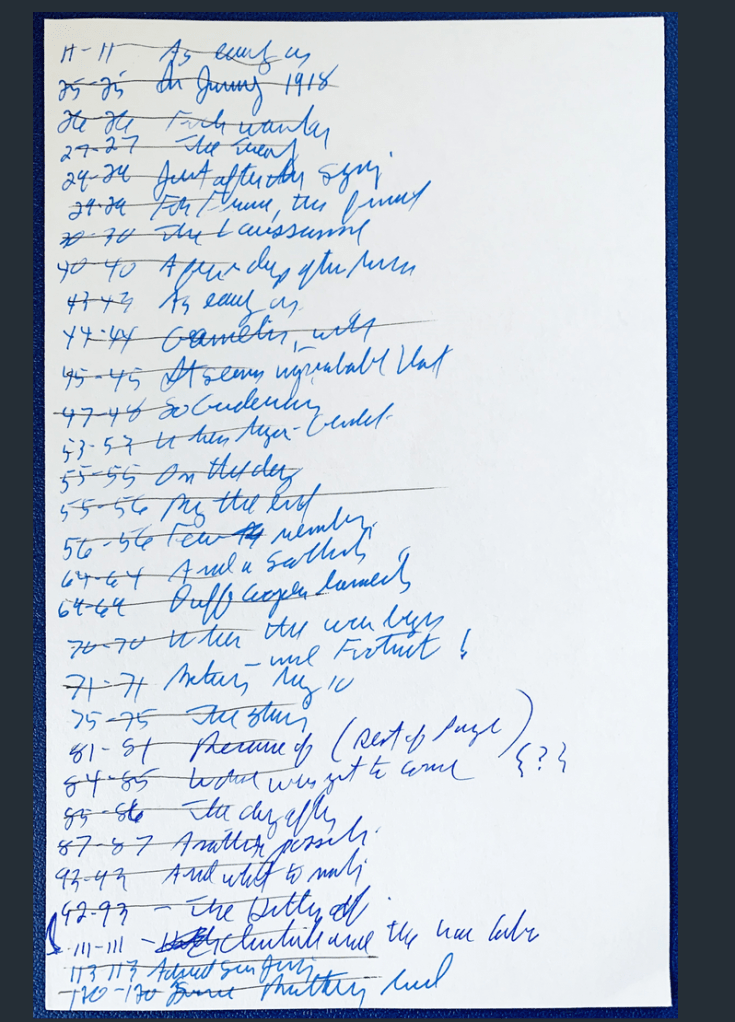
When my reading was done, before transferring Britain Alone to a “Read but Not Transcribed” shelf, I flipped to the back of the book for a quick look at Agar’s notes and sources. To my surprise, I found another marked-up index card lurking in the back pages, smoking-gun-level evidence that I had previously read Britain Alone some months before.
I’ve now read so many books on similar topics, it did not really shock me that I inadvertently read a book a second time. (This has now happened a couple of times). What really surprised me though was what I found when I compared my two sets of notes from my two readings of Britain Alone. Almost every section I had highlighted during my first reading was not highlighted the second time through, and almost every section that I highlighted during my second round was new.
On the index card that tracked my first passage through the book, I had marked 30 sections to include in my notes. On my just-completed second pass, I had marked 21 sections. 17 of those sections were new, only 4 were repeated from my first reading. There was even one page on which I had highlighted one paragraph during my first pass, and a completely different paragraph on my second pass.
It makes sense that my perspective and interests had evolved over time. When I first started my research, just about every fact, every story, and every personality was new to me, and just about everything I read seemed important enough to capture.
As my research evolved, I gradually compiled a more robust outline of the facts – in my mind and in my notes. What I was looking for now was perspective and color. In the words of historian Rick Atkinson, I was searching for “facts to love [in order] to tease coherence and intimacy from the past.” My second reading revealed finer details that had not seemed as important or relevant during my first pass.
For all of my attempts to keep track of my sources and keep score of my progress, these accidental re-readings provided some reassurance that my book is much more than an accumulation of words or a linear collection of facts. It is – I promise – rounding into a continually more interesting story.
Thanks for reading,
Bill
Bill Whiteside
Lancaster, PA
 European History
You must be logged in to post a comment.