
Quite often even the most important step in a man’s life, his choice of vocation, is taken quite frivolously. He does not bother to find out enough about the basis and the various aspects of that vocation. Once he has chosen it, he is inclined to switch off his critical awareness and to fit himself wholly into the predetermined career.
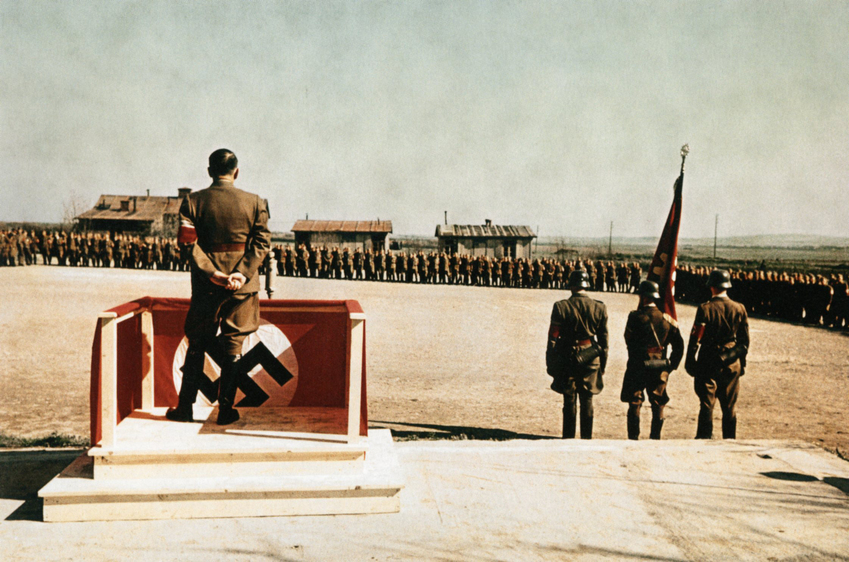
My decision to enter Hitler’s party was no less frivolous. Why, for example, was I willing to abide by the almost hypnotic impression Hitler’s speech had made upon me? Why did I not undertake a thorough, systematic investigation of, say, the value or worthlessness of the ideologies of ALL the parties? Why did I not read the various party programs, or at least Hitler’s Mein Kampf and Rosenberg’s Myth of the Twentieth Century ? 1 As an intellectual I might have been expected to collect documentation with the same thoroughness and to examine various points of view with the same lack of bias that I had learned to apply to my preliminary architectural studies. This failure was rooted in my inadequate political schooling. As a result, I remained uncritical, unable to deal with the arguments of my student friends, who were predominantly indoctrinated with the Nationalist Socialist ideology….
Not, given my education, to have read books, magazines, and newspapers of various viewpoints; not to have tried to see through the whole apparatus of mystification — was already criminal. At this initial stage my guilt was as grave as, at the end, my work for Hitler. For being in a position to know and nevertheless shunning knowledge creates direct responsibility for the consequences — from the very beginning….
Had Hitler announced, before 1933, that a few years later he would burn down Jewish synagogues, involve Germany in a war, and kill Jews and his political opponents, he would at one blow have lost me and probably most of the adherents he won after 1930….
The superficiality of my attitude made the fundamental error all the worse. By entering Hitler’s party I had already, in essence, assumed a responsibility that led directly tot he brutalities of forced labor, to the destruction of war, and to the deaths of those millions of so-called undesirable stock — to the crushing justice and the elevation of of every evil. In 1931 I had no idea that fourteen years later I would have to answer for a host of crimes to which I subscribed beforehand by entering the party.
That was the tone Hitler took. It is easy to imagine how this naturalness of his impressed me — after all, he was not only the Chancellor but also the man who was beginning to revive everything in Germany, who was providing work for the unemployed and launching vast economic programs. Only much later, and on the basis of tiny clues, did I begin to perceive that a good measure of propagandist calculation underlay all this simplicity….
After years of frustrated efforts [as an architect] I was wild to accomplish things — and twenty-eight years old. For the commission to do a great building, I would have sold my soul like Faust. Now I found my Mephistopheles. He seemed no less engaging than Goethe’s.
- During the Nuremberg Trials, Justice Robert H. Jackson referred to Rosenberg’s book as a “dreary treatise[s] advocating a new and weird Nazi religion.” Rosenberg’s work was influenced by both Richard Wagner and Friedrich Nietsche.
 European History