
g
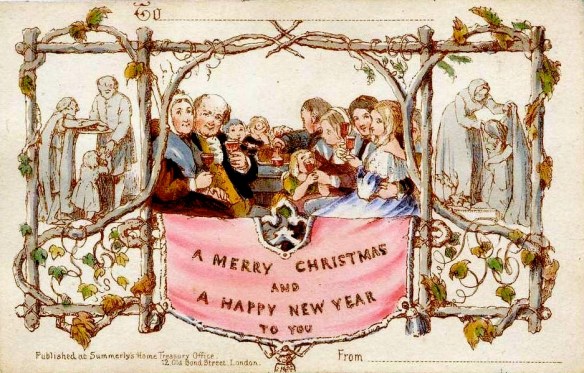
The world’s first commercially produced Christmas card. (1843)
- Father Christmas makes his first appearance in literature in 1616, in a masque by Shakespeare’s contemporary Ben Jonson. Christmas, His Masque is a work by Shakespeare’s great contemporary, Ben Jonson (1572-1637), the playwright who is more famous for writing plays like The Alchemist, Volpone, and Bartholomew Fair. Jonson’s Christmas masque was first performed at the court of King James I (James VI of Scotland) during the Christmas season of 1616.
- The first Christmas cards were sent in 1843, the same year as Charles Dickens’s A Christmas Carol was published. They were designed by London artist John Calcott Horsley. Of the original 1,000 cards that were printed, only 12 are still in existence
- Charles Dickens’s first published piece of writing was a short ‘sketch’ – published when he was in his early twenties – describing the perfect Christmas dinner. The piece offers an insight into what the average nineteenth-century family did at Christmas time. This was in 1835, just before Queen Victoria came to the throne and the idea of the modern Christmas would become firmly entrenched in the national consciousness – and just before Dickens’s own literary career went stratospheric.
- The phrase ‘Christmas pudding’ is first recorded in the diary of Samuel Pepys. According to the Oxford English Dictionary it was first recorded in a 1663 entry in the diary of Samuel Pepys. Pepys began his diary in January 1660 and continued it until 1669, when failing eyesight put an end to his daily jottings.
- The earliest known use of the phrase ‘Christmas pudding’ in a novel is in Anthony Trollope’s 1858 Barsetshire novel Doctor Thorne. Trollope wrote six novels set in the fictional English county of Barsetshire, and Doctor Thorne, the third in the series, is slightly less famous than the previous book in the saga, Barchester Towers. Perhaps this pudding-themed nugget is the most famous thing about it.
- Jean-Paul Sartre’s first ever play was a nativity play, performed at Christmas 1940 by his fellow prisoners of war. The play was called Bariona ou le fils du tonerre (or ‘Baronia, or The Son of Thunder’) and was performed at Stalag XII at Trier in Germany, where Sartre was himself a prisoner during WWII.
- The lyrics to ‘Once in Royal David’s City’ were written by the same person who wrote the words to the hymn ‘All Things Bright and Beautiful’. Her name was Mrs Cecil Alexander,
- Between 1920 and 194and her version of ‘All Things Bright’ is but one of several (although it is the most famous). However, although she’s known in quite a few circles as the Victorian writer of ‘All Things Bright and Beautiful’, she’s less celebrated for her role in Christmas-carol-writing.
- J.R.R.Tolkien wrote a series of letters to his children – letters from ‘Father Christmas’. The Father Christmas Letters were published posthumously in book form in 1976, and document in a light-hearted way some of Father Christmas’s adventures – mostly what he has been up to at the North Pole since the previous year, although some letters tell a more sinister tale involving Goblins, which break into Father Christmas’s house and steal some of the presents.
- A Christmas Carol wasn’t the first Christmas story Dickens wrote. It wasn’t even the first Christmas ghost story Dickens wrote. He’d already written ‘The Story of the Goblins Who Stole a Sexton’, featuring miserly Gabriel Grub, an inset tale in his first ever published novel, The Pickwick Papers (1836-7). The tale shares many of the narrative features which would turn up a few years later in A Christmas Carol: the misanthropic villain, the Christmas Eve setting, the presence of the supernatural (goblins/ghosts), the use of visions which the main character is forced to witness, the focus on poverty and family, and, most importantly, the reforming of the villain into a better person at the close of the story. [Gee, I wonder where Tolkien got his ideas for goblins?!}
- The red robes we now associate with Santa Claus slightly predated the creation of Coca-Cola. Thomas Nast’s cartoons of Santa Claus for Harper’s Weekly in the 1880s appear to have been the first occasion on which the world glimpsed a red-clad Santa. As Joseph J. Walsh puts it in his book Were They Wise Men or Kings? The Book of Christmas Questions, ‘The poor man has not had the opportunity to change his clothes since.’ Indeed, Coca-Cola weren’t even the first soft drinks giant to depict a red-robed Santa. It was another soft drinks company, called White Rock Beverages, that had the idea to use a red-clothed St Nick to advertise their mineral water, in a series of ads run from 1915 onwards.
- Washington Irving, the author of fairy tales such as ‘Sleepy Hollow’ and ‘Rip van Winkle’, helped to inspire the modern American notion of Christmas. Irving drew on traditional English Christmas celebrations that had, at the time, fallen out of fashion on both sides of the Atlantic. Irving spent some time in England and appears to have learnt of various festive traditions during his stay.
 European History