
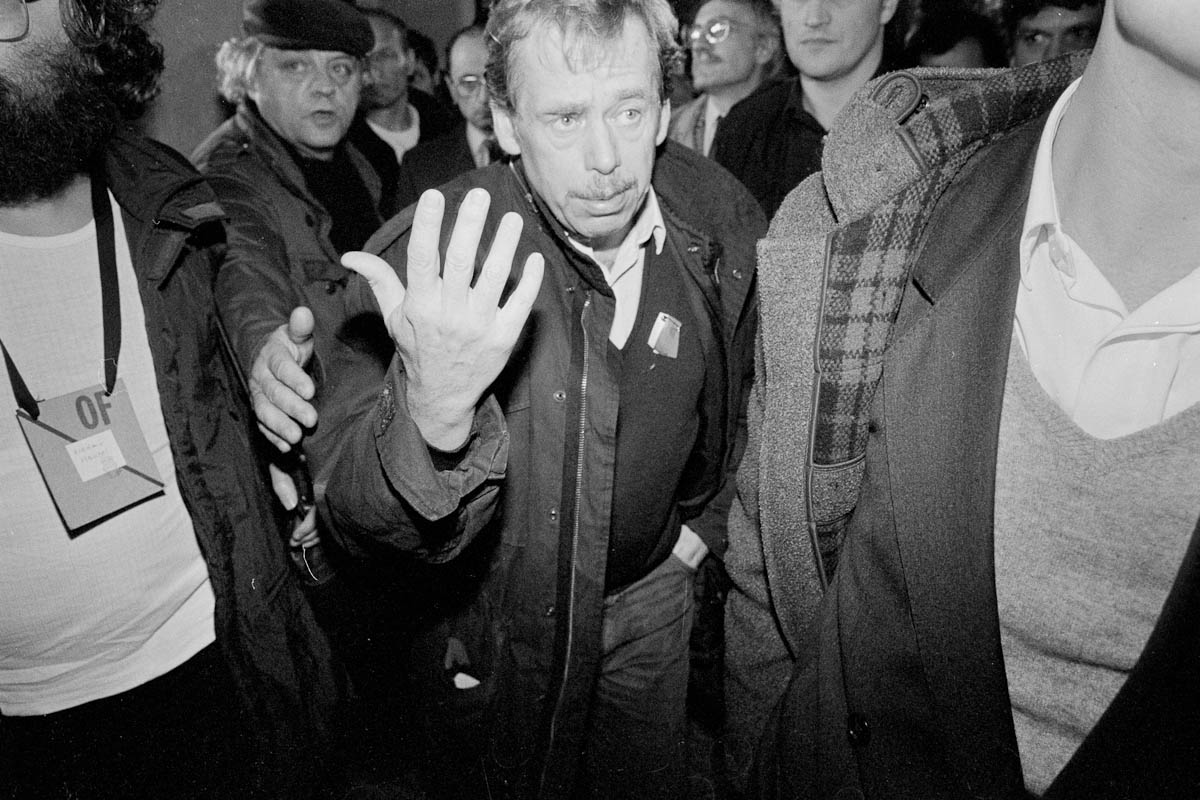
Vaclav Havel, poet and playwright, took part in the reforms of the Prague Spring in 1968. After the Soviet Union invaded Czechoslovakia, his plays were banned, his passport confiscated, and he was arrested multiple times throughout the 1970s and 80s. Subsequent to the Velvet Revolution in 1989, he became the first non-communist president of Czechoslovakia since 1948. He died in 2011.
“Dissident” movements understand systemic change as something superficial, something secondary, something that in itself can guarantee nothing. Thus an attitude that turns away from abstract political visions of the future toward concrete human beings and ways of defending them effectively in the here and now is quite naturally accompanied by an intensified antipathy to all forms of violence carried out in the name of a better future, and by the profound belief that a future secured by violence might actually be worse than what exists now; in other words, the future would be fatally stigmatized by the very means used to secure it. At the same time, this attitude is not to be mistaken for political conservatism or political moderation. The “dissident” movements do not shy away from the idea of violent political overthrow because the idea seems too radical, but on the contrary, because it does not seem radical enough.
For them, the problem lies far too deep to be settled through mere systemic changes, either governmental or technological. Some people, faithful to the classical Marxist doctrines of the 19th century, understand our system as the hegemony of an exploiting class over an exploited class and, operating from the postulate that exploiters never surrender their power voluntarily, they see the only solution in a revolution to sweep away the exploiters. Naturally, they regard such things as the struggle for human rights as something hopelessly legalistic, illusory, opportunistic, and ultimately misleading because it makes the doubtful assumptiion that you can negotiate in good faith with your exploiters on the basis of false legality. The problem is that they are unable to find anyone determined enough to carry out this revolution, with the result that they become bitter, skeptical, passive, and ultimately apathetic — in other words, they end up precisely where the system wants them to be.
 European History