
Essay questions that have appeared on the AP Exam:
- Analyze the impact of the First World War on European culture and society in the interwar period (1919-39).
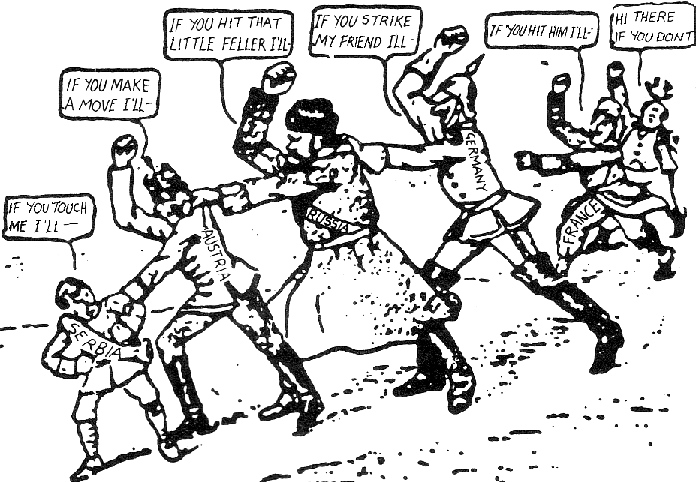
A quick read through the Causes of WWI will give you a fairly thorough overview of the situation in Europe in 1914.
Time Line
- 1905 1st Moroccan Crisis (Germany supports ind to drive wedge between UK and France)
- 1908 Bosnia-Herzegovina annexed by Austria-Hungary heightening tensions w Russia
- 1911 2nd Moroccan Crisis (Germany sends ‘Panther’ gunboat to coast; UK declares honor more precious than peace)
- 29 June 1914 Assassination of Archduke Franz Ferdinand of Austria (Emperor Franz-Joseph’s nephew and heir) in Sarajewo [Ironically, Franz-Ferdinand tended to respect the rights of ethnic minorities within the empire and argued that harsh treatment of Serbia would provoke a war with Russia.]
- 28 July 1914 Austria-Hungary declares war on Serbia
- 1 Aug 1914 Germany declares war on Russia
- 2 Aug 1914 Germany initiates the Schlieffen Plan and occupies Luxemburg (Belgium two days later); “Emergency knows no law” quips the German Chancellor, Bethmann-Holweg
- 3 Aug 1914 After drafting the British ultimatum to Germany upholding Belgian neutrality, British Foreign Sec, Edward Grey remarks: ‘The lights are going out all over Europe; we shall not see them lit again in our lifetime.”
- Aug 1914 Russians meet Germans at the Battle of Tannenberg (Russians suffer 170,000 casualties), one of the only militarily significant battles on the eastern Front.
- Sept 1914 1st battle of the Marne defends Paris — BEF fighting retreat from Belgium — and destroys the Schlieffen Plan
- Nov 1914-May 1915 1st and 2nd Battle of Ypres, part of the Race to the Sea; sees the first large-scale use of poison gas and the virtual annihilation of the British Regular Army
- Apr 1915 – Jan 1916 Britain wages the Gallipoli Campaign against the Ottomans as a way to break into the Black Sea and open supply lines to her ally, Russia. Allies (mostly ANZACs) and Turks suffer 250,000 casualties each. The campaign precipitates the fall of Asquith’s govt in UK and the sacking of Winston Churchill from the Navy, and ends the military career of Sir Ian Hamilton.
- Feb-Dec 1916 Battle of Verdun (“France’s Stalingrad”) becomes the worse battle of attrition ever waged – 700,000 battlefield deaths!
- 1916 Easter Uprising in Dublin; the Irish Republic proclaimed from the central post office – “A Terrible beauty is born” W.B. Yeats
- 1 July 1916 Opening day of the Battle of the Somme; worst DAY in British military history (70,000 killed and wounded – 20% of British forces)
- Apr 1917 Canadians attack at Vimy Ridge (first time all four Canadian divisions go into action together, AND first Entente victory in a year and a half), which has become a nationalist symbol of Canadian sacrifice
- 1917 German Imperial Navy, under the direction of Admiral Tirpitz, declares ‘unrestricted submarine warfare’ as a way to stop supplies getting to Entente powers.
- 1918 Soviet Russia sings the Treaty of Brest-Litovsk; Russia exits the war – fights its own civil war (Reds v Whites) 1919-21.
- March 1918 Germans launch the Ludendorff Offensive on the Western Front with new-style infantry tactics and new units (stormtroopers). [see Ernst Jünger‘s Storm of Steel, pub 1920]
- Sept 1918 260,000 Americans go ‘over the top’ as part of the Meuse-Argonne Offensive, the final push that breaks the German position on the Western Front
- 11 Nov 1918 Armistice goes into effect; thousands die even in the last hours of the war as attacks continue to be launched up to 11am.
- 1919 Germans sign the Treaty of Versailles, the conditions of which were decided upon by the so-called Big Three (UK, France, USA). Germany was forced to accept full responsibility for the conflict (War Guilt Clause) and pay massive reparations (equivalent to $442 billion today – final payment made in 2010); Germany lost Alsace-Lorraine, part of Polish-Prussia, its colonies, its fleet and air force
 European History